
Practical guide
Feedback form templates that lead to real conversations
Four proven forms to copy – for training sessions, manager feedback, peer feedback and the one-to-one. Plus the questions that produce answers you can actually work with on Monday.
The four templates at a glance
What you take away
After this article you will have a form your team is glad to fill in
A good feedback form does three things at once. It collects observations while they are still fresh. It makes the person filling it in think. And it gives the conversation that follows a structure both sides can hold on to.
Three qualities
What makes a feedback form worth filling in
Most forms ask for a verdict. The good ones ask for a situation – and end with a commitment.
The anatomy
Six building blocks every good form is made of
Once you know the sequence, you can put together any form yourself – for a training session just as well as for an annual review.
Occasion and role
What are we talking about, which period are we looking at, and in which role am I filling this in? Three lines that save a lot of confusion later.
Where things stand
How is it going today? The first question always belongs to the person filling in the form – they begin, not the manager.
What great looks like
A picture of the good state, concrete enough to recognise it on Monday.
The evidence
Two situations a camera could have recorded: when and where, what was said, what was done, what came out of it.
Why it is worth it
Why does the step pay off for the person themselves? Whoever sees the benefit takes it willingly.
The commitment
One sentence in the first person, a date, and a time to look back. That is where the form ends – and the working relationship carries on.
Ready to copy
Four feedback form templates for four occasions
All four are written so you can move them into your form tool, your intranet or onto a sheet of paper. Cut freely: a form that is done in seven minutes actually gets filled in.
Feedback form for training and seminars
Right at the end of the session, in the room, with five minutes set aside in the agenda.
Header
- Session, date, trainer
Open questions
- What will you do differently over the next two weeks?
- Which part of the day helped you most with that?
- What would have helped you on top of this?
Scale questions
- The content fits my daily work.does not apply 1 – 2 – 3 – 4 – 5 – 6 fully applies
- I had enough opportunity to practise myself.does not apply 1 – 2 – 3 – 4 – 5 – 6 fully applies
- The pace was right for me.does not apply 1 – 2 – 3 – 4 – 5 – 6 fully applies
- I would recommend this session to a colleague.does not apply 1 – 2 – 3 – 4 – 5 – 6 fully applies
Closing
- Is there anything else you would like to tell us?
The open questions come before the scales on purpose. People who tick numbers first are less likely to write a full sentence afterwards – and the full sentence is what improves the next session.
Feedback form for the one-to-one
Both sides fill it in beforehand, each for themselves. In the meeting the two forms are laid side by side.
Occasion
- The period we are looking at
- One topic we will focus on today
Looking back
- What are you proud of in this period? Name two situations.
- What was harder than you expected?
- Which task would you approach differently today – and how?
Looking ahead
- What would great look like in this topic?
- Which next step would bring the most?
- What do you need from me for that?
- How would we recognise in three months that it worked?
Commitment
- I will …
- By when
- Date for the review
One topic per conversation. Five development areas on one form reliably lead to none of them being worked on.
Peer feedback in ten minutes
For teams giving each other feedback – after a project, a retrospective or a quarter spent working together.
Five questions for a colleague
- What am I grateful to you for? Name one situation.
- What makes working with you easy?
- What would I like to see from you more often – and how would I notice it?
- Which strength of yours would show even more in the team if you brought it forward?
- My contribution to that is …
The fifth question makes the difference. It turns an assessment into an offer – and makes sure both sides take something away.
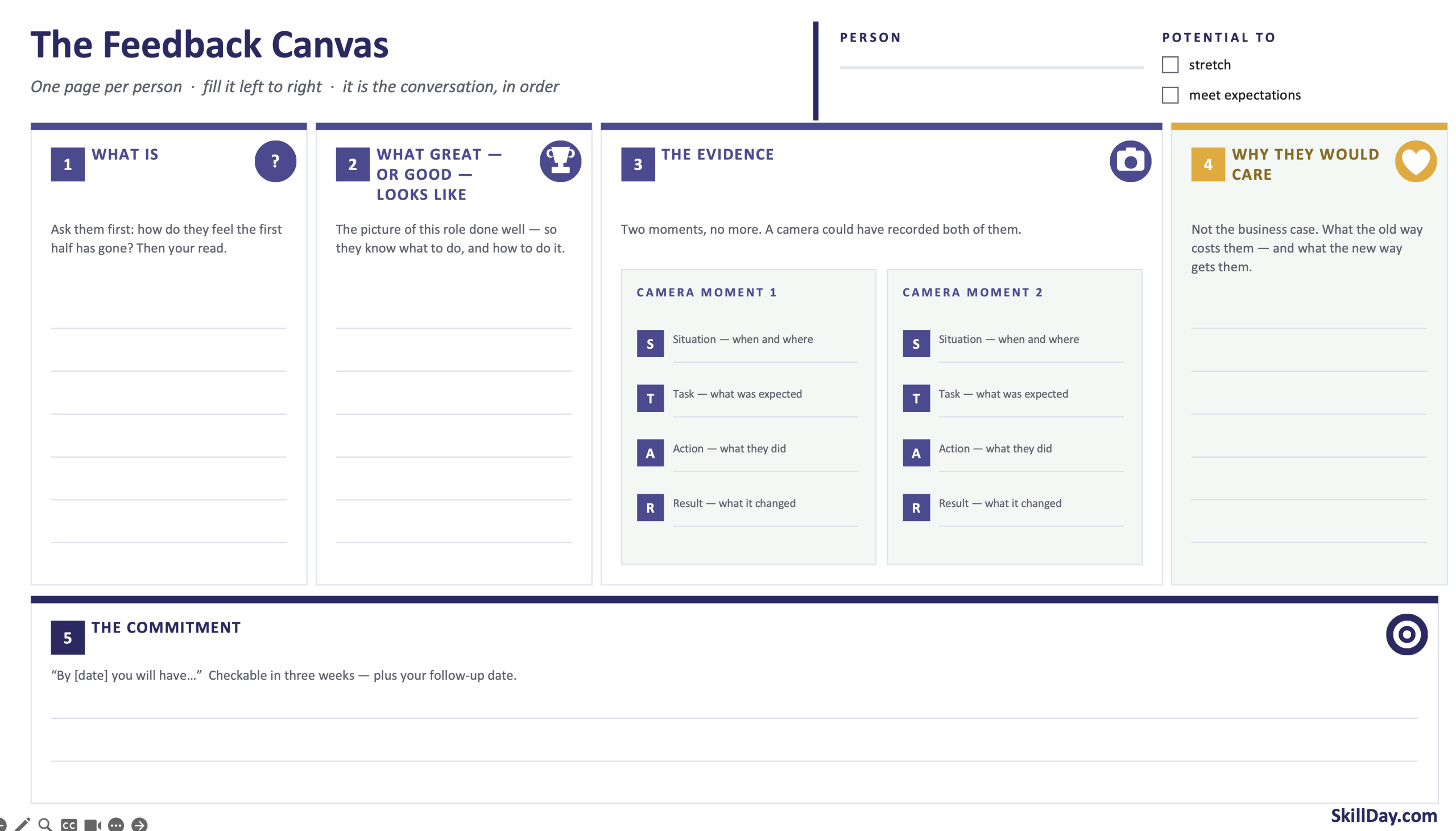
The Feedback Canvas for one conversation
One page per person, filled in from left to right – and discussed in exactly that order.
The canvas brings the six building blocks together on a single sheet. It fits the conversations that deserve more than a form: the first feedback to a new manager, a talk after a project that went differently than planned, or feedback to someone who wants to develop.
The five fields
- What is. How is it going from your point of view? You put this question to the other person first – and listen to the end.
- What great looks like. The picture of the good state, concrete enough to copy on Monday.
- The evidence. Two camera moments: when and where, what was said, what was done, what came out of it.
- Why they would care. The benefit for the person and for the business – what the old way costs and what the new one makes possible.
- The commitment. “By … I will …”, plus a date to look back together.
The canvas is a map for the conversation, not a record. Fill in every line and you lose eye contact. Keywords are enough.
Craft
How to create a feedback form that gets answers
The difference between a form that produces platitudes and one that produces substance is almost always in the wording of the question. Three examples.
“How satisfied were you with the training?”
“What will you do differently over the next two weeks?”
“How would you rate your communication?”
“In which situation over the past four weeks did your feedback help the team?”
“Is there room for improvement?”
“What would have helped you today on top of this?”
Choosing the right scale
Scales are not an end in themselves. They show tendencies across many answers – but they explain nothing. Three rules of thumb:
An even number when you need a tendency
A scale from 1 to 4 or 1 to 6 forces a direction. That helps when you want to know which way the group leans.
An odd number when the middle is a real answer
For questions where “partly” would be the most honest answer, the middle belongs there. Otherwise people guess.
One type of scale per form, with named end points
“Does not apply” to “fully applies” is understood. A bare 1 to 6 gets interpreted – differently by every person.
Six adjustments
Turning the form into a conversation
Plan the time into the agenda
Five minutes at the end of the session bring more substance than an email three days later. The form belongs in the agenda.
Say what happens with the answers
People who know their feedback will be read and answered write differently. One sentence up front is enough.
One question, one thought
“How were the structure and the pace?” gives you one answer to two questions – and you will not know which.
Ask for what is observable
Anything a camera could have recorded can be discussed. Character traits can only be defended.
Play the results back
Two sentences in the next team meeting about what you read and what you will change. That is the best advertisement for the next form.
Close with a commitment
One sentence in the first person and a date. Everything before that is preparation.
The form is the easy part
It gets harder the moment both people are in the room: when the feedback is uncomfortable, when the other side disagrees, when one sentence turns into a debate. That is exactly what we train with managers and teams – on real situations from their own work, not on case studies.
Explore our feedback trainingCommon questions
Questions we are often asked about feedback forms
How many questions should a feedback form have?
Five to ten. What matters is not the number but the time it takes: seven minutes is the line beyond which answers get shorter and response rates drop.
Anonymous or with names?
For group feedback from around eight people upwards, anonymous – honest answers become more likely and individuals stay protected. For feedback between two people, with names, otherwise the conversation has no basis. In both cases, say beforehand who will read the answers.
Paper or digital form?
Paper in the room brings the highest response rate, because the answer is written on the spot. Digital pays off when you want to compare across many sessions. You can combine the two: fill in on paper, type up afterwards.
How often should you ask for feedback?
After every training session. In a team, one short form per quarter. Between a manager and their team members, twice a year – alongside short conversations in between that need no form at all.
What if the answers stay thin?
It almost always comes down to two things: the question is too abstract, or there is no time to fill it in. Replace one rating question with a situation question and give people five minutes in the agenda – the answers change immediately.
May we use these templates inside our company?
Yes. Copy them, cut them, rewrite them and move them into your own form – that is what they are here for.
In-house training
Make feedback work in your team
We train managers and teams to give feedback that lands – with real situations from your own working week, plenty of practice, and a canvas that keeps working long after the training. In English and German, at your offices or live online.
SkillDay works with teams at