
Structure for Presentation: How to Present to Management Clearly and Concisely
Get to the point. Drive decisions. Get buy-in.
Senior management does not want more slides. They want clarity, logic and a clear recommendation.
If your presentation is too long, unclear or interesting but not actionable, it will fail.
The solution is to apply two proven structures:
- The Pyramid Principle for clear logic
- The Hero’s Journey for engagement and buy-in
The Pyramid Principle: Structure your thinking like a consultant
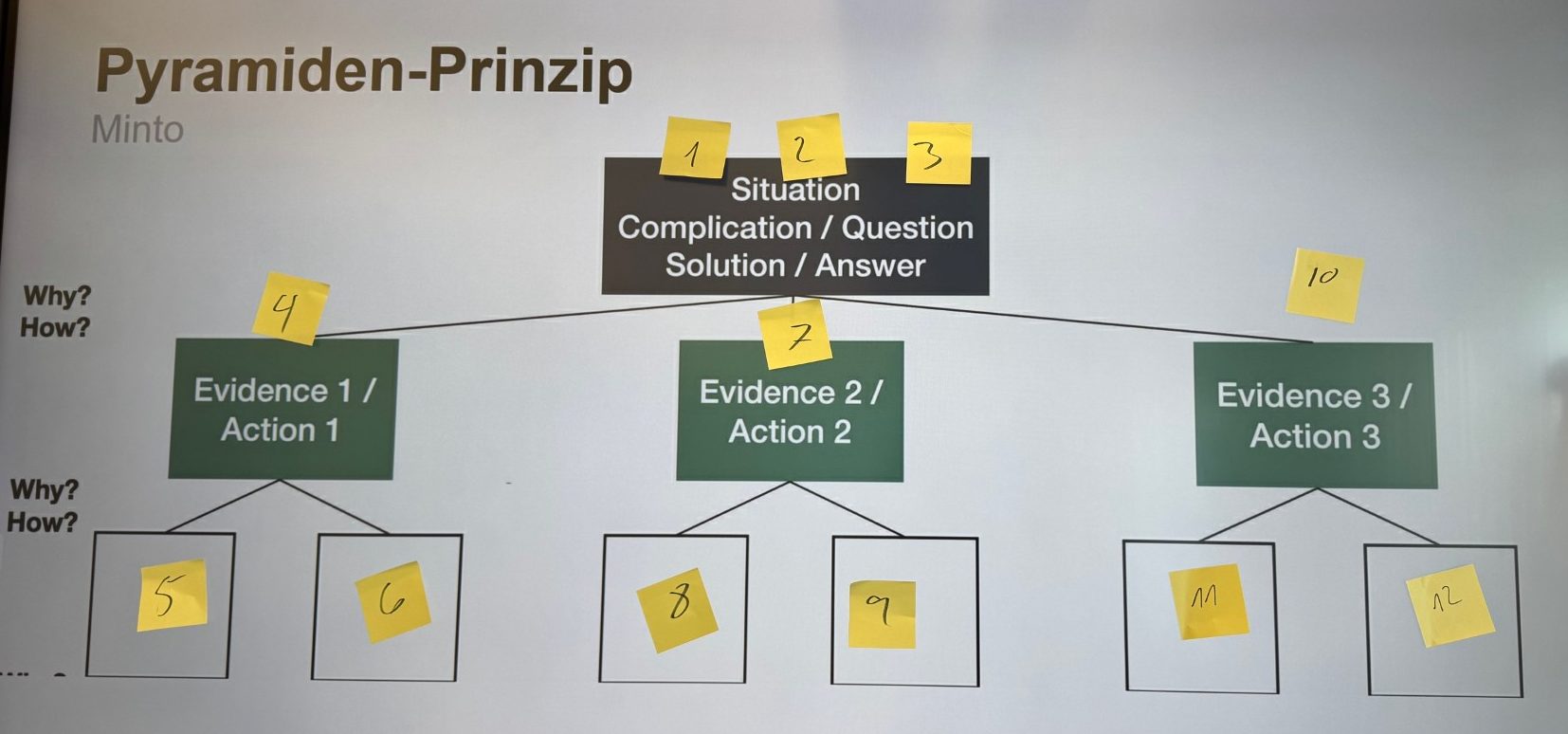
The Pyramid Principle was developed by former McKinsey consultant Barbara Minto. It helps you structure reports, presentations and recommendations clearly and logically.
The core idea is simple: Start with the answer. Then explain why.
Basic structure of the Pyramid Principle
- Situation
- Problem or key question
- Answer or recommendation
- Main argument 1
- Supporting arguments and details to m ain argument 1
- Supporting arguments and details to m ain argument 1
- Main argument 2
- Supporting arguments and details to m ain argument 2
- …
Example
The company places great importance on employee satisfaction. In the annual employee survey, many employees expressed dissatisfaction with unclear goals and priorities. We recommend introducing OKRs to create more transparency around the most important priorities for all employees.
Main part of the presentation
After your recommendation, your audience will usually ask one of two questions:
- Why?
- How?
This is where your main argumentation starts.
Define your main argument lines first. Then support each argument with clear evidence, examples or concrete measures.
Example: Measure 1: All employees receive OKR training form experienced OKR consultants to build a shared understanding of the method.
- All employees take part in a 90-minute live online OKR training.
- All employees receive a practical guide with templates and examples.
- Leadership aligns on how OKRs will be used across the organisation.
Only after you have explained all supporting points for Measure 1 should you move to Measure 2.
Use 3 to 5 main arguments
Barbara Minto recommends using around 5 plus or minus 2 main argument lines. In practice, 3 to 5 arguments are usually ideal for management presentations.
MECE: Make your argumentation clean and complete
Your main argument lines should follow the MECE principle.
MECE means Mutually Exclusive, Collectively Exhaustive.
Mutually Exclusive means that your categories do not overlap. No point belongs in two categories.
Collectively Exhaustive means that all relevant aspects are covered. Nothing important is missing.
A simple example:
- Weak structure: fruit, apples, food
- Better structure: fruit, vegetables, dairy products
This makes your presentation easier to follow and your recommendation easier to assess.
The Hero’s Journey: A universal structure for presentations
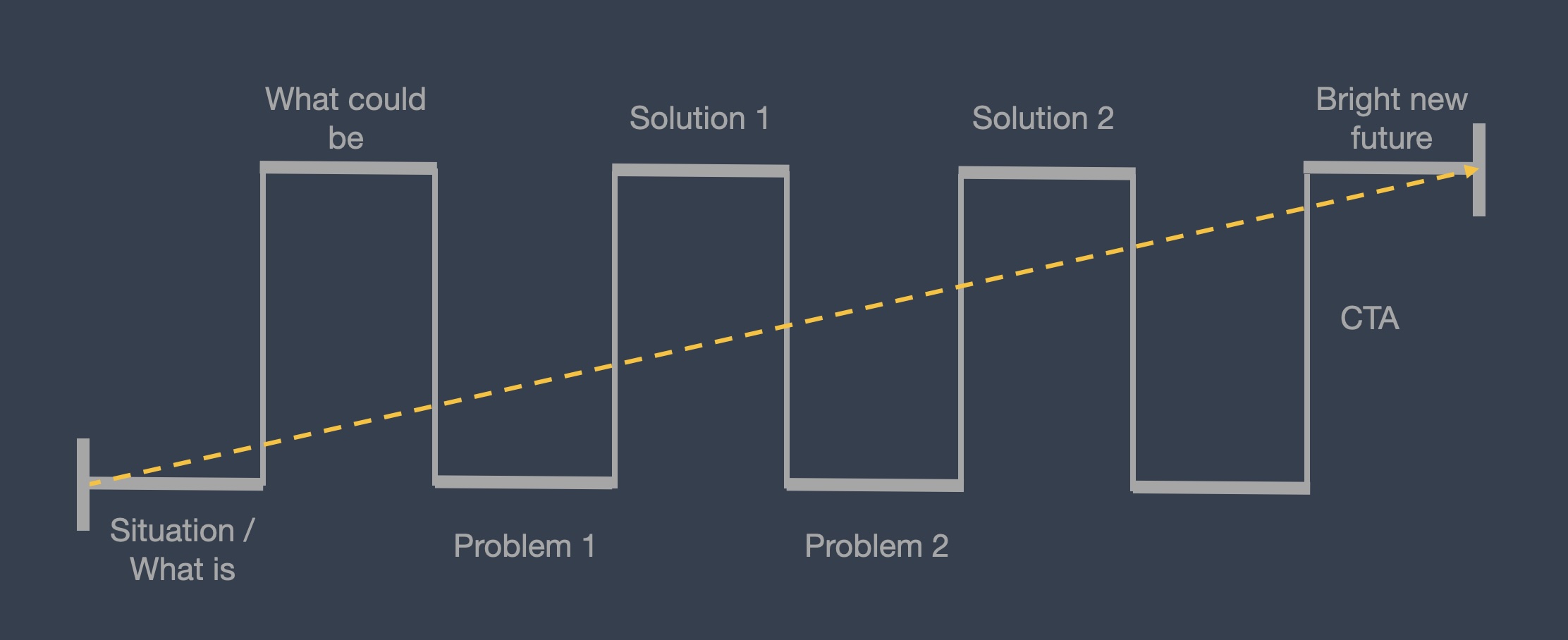
The fundamental idea of the Hero’s Journey is simple:
Your audience is the hero. You are the mentor.
As the presenter, your role is not to be the star of the story. Your role is to guide your audience, provide insight and help them move from the current situation to a better future.
Presentation structure using the Hero’s Journey
1. Introduction: The current world and the call to adventure
Start by describing the familiar world of your audience. Create a shared understanding of the current situation.
The goal is maximum agreement. Your audience should think: Yes, that is exactly our situation.
Then describe the central challenge. Do not go too deep yet. Focus on the big picture.
This creates a shared starting point and opens a knowledge gap. You then introduce your big idea: a solution that removes pain or creates a clear improvement.
2. Main part: How the hero can overcome the obstacles
In the main part, you resolve the tension you created at the beginning.
Show how the most important problems can be overcome through concrete solutions.
A strong Hero’s Journey presentation uses contrast:
- What is the challenge (problem plus implication)?
- What is the solution plus benefit?
This contrast keeps attention high and makes the value of your recommendation visible.
You give your audience the tools, knowledge and confidence to overcome the obstacles ahead.
3. Ending: Clear call to action
The end of your presentation needs two elements:
- A concrete call to action
- A short reinforcement of your central idea
Your call to action should be specific. For example:
- Approve the budget
- Start a pilot project
- Schedule a follow-up meeting
- Visit a website
- Make a decision today
Then remind your audience why the goal is realistic and worth the effort.
Steve Jobs also used the Hero’s Journey
Steve Jobs often positioned the audience as the hero and Apple as the guide that helped people achieve something better.
A well-known example is the 2007 iPhone launch. Jobs first described the familiar world of mobile phones, then highlighted the frustration with existing devices and finally introduced the iPhone as the better future.
This made the presentation easy to follow, emotionally engaging and highly memorable.
Final takeaway
If you want to present to management, do not start with background information.
Start with the answer.
Then use a clear structure to explain why your recommendation makes sense and what should happen next.
The Pyramid Principle gives your presentation logic. The Hero’s Journey gives it energy.
They help you present clearly, stay concise and increase the chance that management makes a decision.
Presentation Training for Management Presentations
If you want your team to present more clearly, structure recommendations better and create management-ready slides, our presentation skills training for teams can help. For managers and executives, you can also hire our presentation coach for 1on1 sessions.
In any case, we teach how to structure presentations with proven frameworks like the Pyramid, the Hero’s Journey, Recommendation and others. In addition, we also share practical slide design methods. The focus is always on real business presentations and immediate application.
Interested in an inhouse training or workshop? Get in touch with us.